 CabinetMaxillo·Facial
The only single-specialty orofacial physiotherapy practice in Brussels: TMJ disorders, bruxism, post-surgical rehabilitation, facial palsy. Assessment and follow-up are measured, in millimetres and validated scores, and a one-page report can be shared with your doctor.
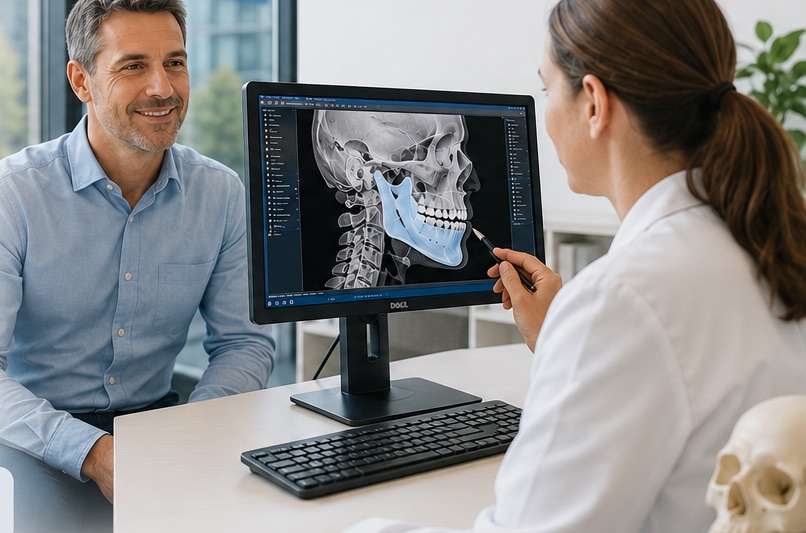
Christophe Delfosse, physiotherapist (Master's degree, ULB — Université libre de Bruxelles), over ten years of practice, treats only the orofacial sphere. Temporomandibular disorders affect about one adult in three at some point in life; most respond well to conservative care, without surgery. The practice is at Boulevard de la Cambre 46, 1000 Brussels — tram 8 (Legrand) and metro Louise nearby — about 10 minutes by car or taxi from the Schuman roundabout and the EU quarter.
Jaw pain, clicking, locking, limited mouth opening. The core of the practice.
Teeth grinding and clenching, tense jaw muscles, morning headaches. Beyond the night guard.
Orthognathic and maxillofacial post-surgical rehabilitation, with a measured protocol.
Every assessment includes reproducible measurements: mouth opening in millimetres, deviation, lateral movements, plus two validated instruments — the OMES protocol (Felício & Ferreira, 2008) and the JFLS-8 scale from the international DC/TMD framework.
You leave with a one-page report, and with your consent, so does your doctor, dentist or surgeon. Also treated: facial palsy, neck pain linked to the jaw, somatosensory tinnitus, tongue posture re-education, preparation before dental or maxillofacial surgery.
A structured pathway, whatever brings you in.
Choose a slot online or call. Bring your prescription if you have one, and any imaging or surgical report.
History, clinical examination and baseline measurements: millimetres, functional scores, muscle assessment.
Manual therapy, exercises and habit work, explained and agreed with you, with a realistic timeline.
Progress re-measured across sessions. A one-page report for you, and your doctor with your consent.
Yes. Consultations are available in English and French. Many patients come from the European institutions and the international community in Brussels.
For most physiotherapy care in Belgium, a medical prescription is required for reimbursement. Since 2026, direct access is possible for mild symptoms; reimbursement conditions are explained at the first visit.
Boulevard de la Cambre 46, 1000 Brussels, at the edge of Bois de la Cambre, close to Avenue Louise. Tram 8 (Legrand stop) and metro Louise are nearby, about 10 minutes from the Schuman roundabout.
Yes. Follow-up sessions last 20 to 30 minutes; with the trip from the EU quarter, a session fits in a standard lunch break. Early-afternoon and end-of-day slots are also available online.
Daytime clenching linked to work stress is a classic bruxism pattern, and it is treated by orofacial physiotherapy: muscle treatment, habit-reversal work and, where useful, coordination with your dentist about a guard. An assessment measures your baseline first. See the bruxism page.
Clicking with normal teeth usually points to the joint or the masticatory muscles rather than the teeth. That is exactly the scope of orofacial physiotherapy: a measured assessment tells you whether treatment is useful, and a one-page report goes back to your dentist. See the TMJ page.